New Posts
  • Hi there guest! Welcome to PoliticalJack.com. Register for free to join our community?

A World Without Work

This sounds like a good communists dream. It doesn't address the jobs issue, just the management issue and with robotics that will not be an issue.
I think the Big Issue will be how the GDP produced by robots gets distributed. Currently, the 20 richest citizens of the US have more wealth than 160,000,000 of their countrymen and women. Capitalism seems to guarantee that level of inequality will only worsen as more and more jobs are automated. Possibly your point about jobs can only be resolved by separating income from employment?
 
I think the Big Issue will be how the GDP produced by robots gets distributed. Currently, the 20 richest citizens of the US have more wealth than 160,000,000 of their countrymen and women. Capitalism seems to guarantee that level of inequality will only worsen as more and more jobs are automated. Possibly your point about jobs can only be resolved by separating income from employment?
Nature has a long record of balancing itself out. Have faith.

The system you are describing is unsustainable. Something has to give.
 
So everybody is and wants the same thing?
o_O
I sincerely hope not.

I was trying to contrast today's typical capitalist workplace with its indifference to unemployment, unused resources, and unmet demand all happening at the same time with a workplace where "everyone would have equivalent hours worked so no 'unemployment would ever need to exist."

CH Douglas said it much better than I

"Douglas claimed there were three possible policy alternatives with respect to the economic system:

1. The first of these is that it is a disguised Government, of which the primary, though admittedly not the only, object is to impose upon the world a system of thought and action.

2. The second alternative has a certain similarity to the first, but is simpler. It assumes that the primary objective of the industrial system is the provision of employment.

3. And the third, which is essentially simpler still, in fact, so simple that it appears entirely unintelligible to the majority, is that the object of the industrial system is merely to provide goods and services.[12]

https://en.wikipedia.org/wiki/Social_credit#Purpose_of_an_economy
 
Nature has a long record of balancing itself out. Have faith.

The system you are describing is unsustainable. Something has to give.
We seem to be approaching a tipping point where human engineered problems of increasing population and decreasing job prospects have created an imbalance that doesn't provide nature with sufficient time to address?
 
We seem to be approaching a tipping point where human engineered problems of increasing population and decreasing job prospects have created an imbalance that doesn't provide nature with sufficient time to address?
Dude, mankind is part of nature. ;)

A few years ago I read an article by the author of a book about how many things don't come to be until they are needed. He listed several examples. I wish I could remember the title, but the gist is that many our current problems will be solved one way or another just as all of our past ones have been solved.
 
Roller coasters are better than merry-go-rounds.

I totally agree. I have always told my students that I, for one, greatly prefer the roller coaster ride of capitalism to the socialist merry-go-round. But people differ in values, and some may genuinely prefer the more staid ride.
 
Dude, mankind is part of nature. ;)

A few years ago I read an article by the author of a book about how many things don't come to be until they are needed. He listed several examples. I wish I could remember the title, but the gist is that many our current problems will be solved one way or another just as all of our past ones have been solved.

Well, that's just the very old argument that "Necessity is the mother of invention". But I can tell you that there are historians of technology who think that is a silly aphorism. A different and possibly more truthful version says that "Invention is the mother of necessity." Example: When automobiles were invented, they could not become truly useful until a whole host of subsidiary inventions and institutions sprang up. You needed gas stations, and paved roads, and glass manufacturers, and tire manufacturers, and so forth. Sadly, inventions don't always come about just because we 'need' them; that's about like supposing that the U.S. cavalry will always come riding to the rescue just in the nick of time, like in all the old-time Westerns. China desperately NEEDED inventions in the 17th and 18th centuries, when they had lost their earlier inventiveness, did not get them, and the result was massive famines.......
 
ou don't need to suspend the profit motive in human commerce in order to make sure that growing productivity translates into widespread prosperity growth and leisure time increases. We have a model from the industrial revolution, when there was a gigantic increase in productivity.
One big difference between today and the dawn of industrialization is the number of available jobs. We have millions more who need jobs today competing with tens of millions more robots. Maybe we need a new economic paradigm?
 
Well, that's just the very old argument that "Necessity is the mother of invention". But I can tell you that there are historians of technology who think that is a silly aphorism. A different and possibly more truthful version says that "Invention is the mother of necessity." Example: When automobiles were invented, they could not become truly useful until a whole host of subsidiary inventions and institutions sprang up. You needed gas stations, and paved roads, and glass manufacturers, and tire manufacturers, and so forth. Sadly, inventions don't always come about just because we 'need' them; that's about like supposing that the U.S. cavalry will always come riding to the rescue just in the nick of time, like in all the old-time Westerns. China desperately NEEDED inventions in the 17th and 18th centuries, when they had lost their earlier inventiveness, did not get them, and the result was massive famines.......
There's certainly truth in your examples. A favorite past television show was James Burke's "Connections" (he did a similar documentary series title "The Day the Universe Changed") which covered how technological advances led to where we are.

A game example of this is "Civilization" (my favorite was Civ II) where advances in technology led to other things.

Back to the book previously mentioned, it doesn't contradict these ideas, but it does use them. We wouldn't have our present problems of overpopulation, pollution and depletion of resources if we didn't have the tech to sustain them. Take away the tech and a lot of these problems will go away on their own when a massive amount of the population dies off as a result.

One way or another, a non-sustainable situation will be resolved.
 
Brother, can you paradigm?

:p
Economic-Paradigm1.jpeg

Ready for the big shift?
 
Economic-Paradigm1.jpeg

Ready for the big shift?


Looks like a synopsis of Kondratiev (or Kondratieff) waves, which involve long-run cycles of some 50-60 years. Orthodox economists are skeptical of the idea, for two main reasons: (1) No one has really come up with a plausible explanation for why major inventions should 'cluster' every 50 or 60 years; and (2) there has only been enough time for roughly four complete cycles since the beginning of the Industrial Revolution, and a good statistician would tell you that is not quite enough cycles to demonstrate cyclical behavior to a high degree of confidence.

But, anyway, I prefer Smihula's Modified Kondratieff Scheme:

1600-1780: The Financial/Agricultural Revolution

1780-1880: The Industrial Revolution

1880-1940: The Technical Revolution

1940-1985: The Scientific/Technical Revolution

1985-2015: The Information/Telecommunications Revolution

2015-2035: The Hypothetical Post-Informational Technical Revolution (based on the GRIN technologies, perhaps?)

I prefer this scheme to Kondratieff's original scheme, because it shows a pattern of acceleration. With the cycles getting shorter and shorter in time.

More if you are curious...
 
But, anyway, I prefer Smihula's Modified Kondratieff Scheme:

1600-1780: The Financial/Agricultural Revolution

1780-1880: The Industrial Revolution

1880-1940: The Technical Revolution

1940-1985: The Scientific/Technical Revolution

1985-2015: The Information/Telecommunications Revolution


2015-2035: The Hypothetical Post-Informational Technical Revolution (based on the GRIN technologies, perhaps?)
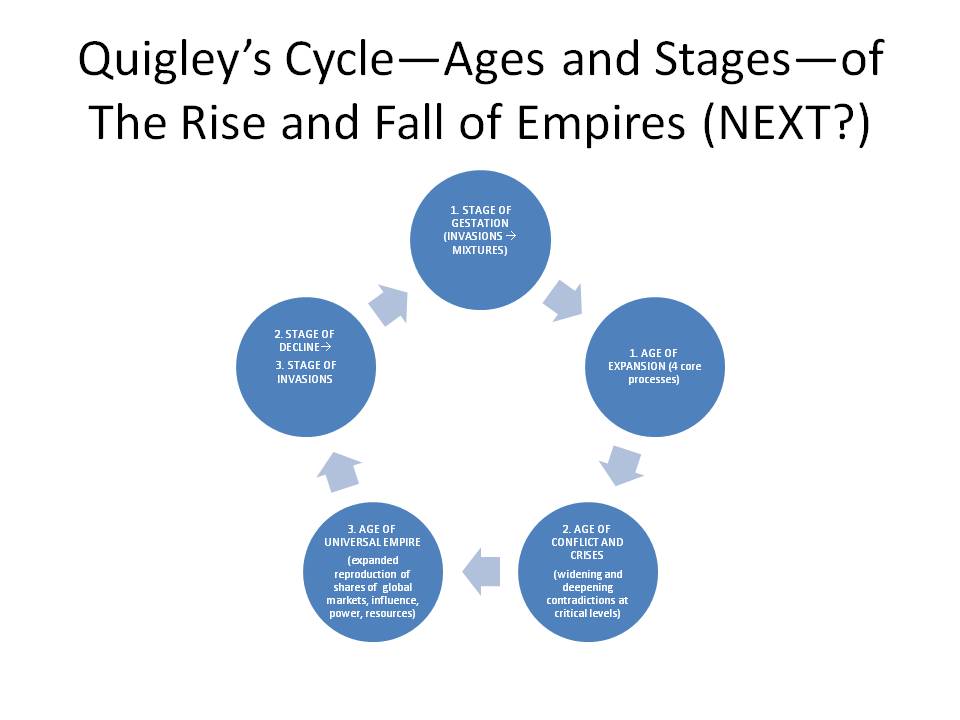
Do you see any potential overlap between Smihula's Modified Kondratieff Scheme and Carroll Quigley's Ages and Stages of Empires?
slide151.jpg

Full Disclosure: I didn't even know I was posting Kondratiev waves until you mentioned it.:rolleyes:
 
One big difference between today and the dawn of industrialization is the number of available jobs. We have millions more who need jobs today competing with tens of millions more robots. Maybe we need a new economic paradigm?
Maybe. But, again, consider the way labor supply was deliberately decreased in that era. Imagine if progressive politics never happened. Imagine if it had remained possible to staff factory jobs with 10-year-olds, and to make people work 70-hour-weeks for almost no pay, without vacations or even weekends or disability pay. Imagine if people had continued to be made to work until they were dead, with no Medicare and Social Security to make it possible for the majority to step away from the job market at some point. Imagine if widespread public schooling and subsidized student loans hand't allowed for a large portion of our teens and twenty-something not to be working. In that case, you would have seen the same issue of millions more needing jobs than were needed to do the work, thanks to the way automation was multiplying the efforts of workers. But, when all those progressive policies are taking some workers out of the workforce (the very young and very hold), while reducing the annual hours you can get out of the rest, that allows for more of a balance between labor and capital, even in a situation where productivity is soaring. What changed is that we stopped further restricting labor supply, even as productivity continued to advance, leading to imbalance. In fact, labor supply increased due to the breakdown of social taboos against women working outside the home.
 
Do you see any potential overlap between Smihula's Modified Kondratieff Scheme and Carroll Quigley's Ages and Stages of Empires?
slide151.jpg

Full Disclosure: I didn't even know I was posting Kondratiev waves until you mentioned it.:rolleyes:

Sorry it took me so long to get back to this very interesting thread----FAR more interesting than your run-of-the-mill Political Jack thread!

I am familiar with Quigley's work, having read his seminal work on the rise and fall of civilizations. I am not sure that there is any overlap with Kondratieff cycles, for the following (main) reason: Quigley is discussing the rise and fall of empires, something that takes place over a time period of centuries. [Rome was not built in a day, and it didn't fall in a day, either!] Whereas Kondratieff waves are referring to a purely economic phenomenon that (allegedly) takes place over a period of decades. Nevertheless, the general outline of the two schemes does have some interesting parallels, and I can easily understand why a person might draw a connection. I am just not persuaded that one really exists.
 
Back
Top