New Posts
  • Hi there guest! Welcome to PoliticalJack.com. Register for free to join our community?

Question for Conservatives on Global Warming

Doesn't matter, according to mtzldick, humans were entirely responsible for global warming nearly 200 years before we had cars. So it doesn't matter what we do to stop global warming according to Mtzldick, because there is no way we can get out carbon footprint down to what it was 250 years ago.

May as well kiss the Earth goodbye and enjoy ourselves. :)

You might want brush up on your spelling...LOL
 
Some of you are not convinced as to the view of climate change that has been embraced by the majority of experts (that human activities are predominantly responsible for the current global warming trend, and that if we don't curb greenhouse gas emissions significantly, there will be climate changes that will cause mankind severe problems). What would it take to convince you?

Presumably you can at least agree that if the majority of experts were right, it would be a very big deal, and we'd be wise to do something about it. So, presumably you can also agree that we should be making an effort to figure out if what the majority of experts say is happening is actually happening. So, what form should that effort take? How should we be looking into the question, and when will we know we have enough confidence in the findings to justify actions such as laws designed to reduce greenhouse gas emissions?

Governments addressed those very questions back in the 1980s. At the time, there were a lot of signs as to what was going on with global warming and how serious it might be, but governments had to figure out a way to pull that science together so they'd know whether various policy proposals made sense. Their solution was to set up the IPCC -- an international panel staffed by top climate scientists from all over the world. They would form various working teams of subject-matter experts, to examine all the component issues about the climate change question. The working groups would review all the published scientific research in each of those subject areas. Then their job would be to bring it together into a single clear picture that the public and policy-makers could use in deciding how to proceed. The idea was to make it a conservative panel, by requiring universal consent by all member countries before something could make it into an IPCC report, so that unsupported alarmist beliefs of a minority wouldn't make the cut.

That was a quarter century ago, and much has passed since then. The IPCC has released five major reports, each updating and fine-tuning the information based on the latest research. At each stage, a larger share of scientists became convinced of the majority position, and at each stage the IPCC upped the probability they ascribed to the findings, in light of ever-greater evidence. When we speak of a consenus view on climate change, it's the IPCC summary we're talking about, and nearly every major scientific body in the world has either echoed that view, or has expressly deferred to the IPCC on it. For example, the governing bodies of the national academy of science for each of the 34 leading nations of the world have all endorsed the consensus position, and the academies of the 13 top nations (including the US) issued a joint statement saying:

"It is unequivocal that the climate is changing, and it is very likely that this is predominantly caused by the increasing human interference with the atmosphere. These changes will transform the environmental conditions on Earth unless counter-measures are taken."

To me, the idea of a panel like the IPCC (to pull together the research and provide clear guidance to lay people and politicians) seemed like a perfectly sensible approach to the problem of deciding whether various policies made sense in light of the supposed threat. I can't come up with a better way to approach the problem. And given the fact that there's been such overwhelming concurrence among all the major science foundations, national academies, and relevant professional bodies, it seems that those who understand the issue better than me have generally been convinced, too. But for those of you who haven't been convinced, what would do it?

How would you propose that the science be brought together in order to inform policy-making, if the IPCC approach didn't do it for you? Politicians and lay people are never going to read the hundreds of thousands of pages of primary research being published every year, and even if they did, they couldn't follow it. So, you need some sort of mechanism for creating a synthesis of that work that policymakers and lay people can understand. If the IPCC wasn't a good mechanism for that, what do you propose? And what would it take for you to be convinced that serious efforts to limit greenhouse gas emissions were called for?

Allow me to try and explain why you'll likely never get an intelligent response to such questions.

Did you ever wonder why they gleefully embrace some of the stupid crap they do, like the current cold weather or snowmageddons disproving global warming, or the obvious fact that they can't overcome the evidence for AGW but deny it anyway? Well, it's related to their scoffing at the use of sources like say, DKos based on credibility they can't really substantially undermine -- they simply don't trust the opposition, a tribal thing. http://desmog.ca/2014/01/27/why-it-s-not-enough-be-right-about-climate-change That's why I've long contended that there's no getting over, around, or under their BS mountain, and adding the easily found positive reinforcement from their peers, you have the recipe for the unshakeable denials we beat our head against the wall fruitlessly over.

It's also coincidentally, one of the reasons why I think the inevitable prevailing of experience and time over their AGW denials will have a transformative effect in size and type none before it have enjoyed. The "we're gonna have to work on this existential threat together" nature of it coupled to the realization and then formed consensus pov that "we're only in this mess to the extent we are and will continue to be predominatly because of the decades long rightwing battle against it", is gonna knock the current crazy (and the worse I expect them to become before then) right outta them.

Hopefully I'll live long enough to witness that...lol

I'm sure there are some reliable means to get in the ball park with a figure representing the human toll caused by that inaction as a result of their obstruction, and I'm sure before some of us here are dead, worldwide the figure will likely be quite high. This one is iffy to me, because I think only the brightest of them (the ones trickling down the turds) have considered it, and obviously don't care about how future generations will judge them. For the flat earthers spewing their nonsense here, they don't believe it's happening, so the additional human misery and deaths they're supporting aren't even up for consideration.

You have to get over the hump of belief with these clowns before you can get a real response, and given that the solutions are inevitably gonna involve and most likely require "big government/socialism", well, then you hit the next wall to beat your head against.

hope this helps

have a good one arky
 
for those who believe in science, climate change is settled. it's fact.
for primitives who believe the Bible trumps science, it isn't.
If you were right, which you're not, the left has done a horrendous job convincing Americans it's real and needs immediate action. It is a low priority issue- bottom of the list- when Americans are asked open-ended which policies demand action. If the science is settled, Americans are simply not convinced your side has any workable solution. And that's true- there isn't one.
 
Some of you are not convinced as to the view of climate change that has been embraced by the majority of experts (that human activities are predominantly responsible for the current global warming trend, and that if we don't curb greenhouse gas emissions significantly, there will be climate changes that will cause mankind severe problems). What would it take to convince you?

Presumably you can at least agree that if the majority of experts were right, it would be a very big deal, and we'd be wise to do something about it. So, presumably you can also agree that we should be making an effort to figure out if what the majority of experts say is happening is actually happening. So, what form should that effort take? How should we be looking into the question, and when will we know we have enough confidence in the findings to justify actions such as laws designed to reduce greenhouse gas emissions?

Governments addressed those very questions back in the 1980s. At the time, there were a lot of signs as to what was going on with global warming and how serious it might be, but governments had to figure out a way to pull that science together so they'd know whether various policy proposals made sense. Their solution was to set up the IPCC -- an international panel staffed by top climate scientists from all over the world. They would form various working teams of subject-matter experts, to examine all the component issues about the climate change question. The working groups would review all the published scientific research in each of those subject areas. Then their job would be to bring it together into a single clear picture that the public and policy-makers could use in deciding how to proceed. The idea was to make it a conservative panel, by requiring universal consent by all member countries before something could make it into an IPCC report, so that unsupported alarmist beliefs of a minority wouldn't make the cut.

That was a quarter century ago, and much has passed since then. The IPCC has released five major reports, each updating and fine-tuning the information based on the latest research. At each stage, a larger share of scientists became convinced of the majority position, and at each stage the IPCC upped the probability they ascribed to the findings, in light of ever-greater evidence. When we speak of a consenus view on climate change, it's the IPCC summary we're talking about, and nearly every major scientific body in the world has either echoed that view, or has expressly deferred to the IPCC on it. For example, the governing bodies of the national academy of science for each of the 34 leading nations of the world have all endorsed the consensus position, and the academies of the 13 top nations (including the US) issued a joint statement saying:

"It is unequivocal that the climate is changing, and it is very likely that this is predominantly caused by the increasing human interference with the atmosphere. These changes will transform the environmental conditions on Earth unless counter-measures are taken."

To me, the idea of a panel like the IPCC (to pull together the research and provide clear guidance to lay people and politicians) seemed like a perfectly sensible approach to the problem of deciding whether various policies made sense in light of the supposed threat. I can't come up with a better way to approach the problem. And given the fact that there's been such overwhelming concurrence among all the major science foundations, national academies, and relevant professional bodies, it seems that those who understand the issue better than me have generally been convinced, too. But for those of you who haven't been convinced, what would do it?

How would you propose that the science be brought together in order to inform policy-making, if the IPCC approach didn't do it for you? Politicians and lay people are never going to read the hundreds of thousands of pages of primary research being published every year, and even if they did, they couldn't follow it. So, you need some sort of mechanism for creating a synthesis of that work that policymakers and lay people can understand. If the IPCC wasn't a good mechanism for that, what do you propose? And what would it take for you to be convinced that serious efforts to limit greenhouse gas emissions were called for?
It would take at least three things:
1. Accuracy
2. Consistency
3. Credibility
All three aspects are lacking when the topic turns to climate change/ global warming.
The predictions have been inaccurate. The models are admittedly lacking many factors and changes made over a period of years have not yielded consistent verifiable results.
The weather report is famously inaccurate and meteorology the butt of jokes and the subject of scorn to vacationers, beachgoers, campers, gardners etc. The idea that predictions for what conditions the earth faces 20+ years from now seem ridiculous to a majority of Americans.
The approach and possible solutions to climate change are unsure and inconsistent. Some true believers claim we might not even be able to reverse the trends already occurring. Climatologists are of many different mindsets as to what future trends will show and to what degree we can affect them. The credibility for the argument sure takes a hit when Hollywood celebs who know as much about climate as they do nuclear fission make silly unprovable doom and gloom predictions that are so short-term and over the top and Al Gore admitting exaggerating the problem is a good tactic for keeping it relevant sure don't help.
So consistent and accurate short-term observations from credible sources would go a long way to swaying Americans to back action. Consistent solutions that don't inconvenience Americans or promise bankruptcies for certain businesses would also help people sympathize with this perceived problem.
 
I don't understand why anyone would bother to question right-wingers about anything so complex as global climate science. They have repeatedly demonstrated that they are incapable of processing a concept so expansive that it will not fit on a bumper sticker.
 
Some of you are not convinced as to the view of climate change that has been embraced by the majority of experts (that human activities are predominantly responsible for the current global warming trend, and that if we don't curb greenhouse gas emissions significantly, there will be climate changes that will cause mankind severe problems). What would it take to convince you?

Presumably you can at least agree that if the majority of experts were right, it would be a very big deal, and we'd be wise to do something about it. So, presumably you can also agree that we should be making an effort to figure out if what the majority of experts say is happening is actually happening. So, what form should that effort take? How should we be looking into the question, and when will we know we have enough confidence in the findings to justify actions such as laws designed to reduce greenhouse gas emissions?

Governments addressed those very questions back in the 1980s. At the time, there were a lot of signs as to what was going on with global warming and how serious it might be, but governments had to figure out a way to pull that science together so they'd know whether various policy proposals made sense. Their solution was to set up the IPCC -- an international panel staffed by top climate scientists from all over the world. They would form various working teams of subject-matter experts, to examine all the component issues about the climate change question. The working groups would review all the published scientific research in each of those subject areas. Then their job would be to bring it together into a single clear picture that the public and policy-makers could use in deciding how to proceed. The idea was to make it a conservative panel, by requiring universal consent by all member countries before something could make it into an IPCC report, so that unsupported alarmist beliefs of a minority wouldn't make the cut.

That was a quarter century ago, and much has passed since then. The IPCC has released five major reports, each updating and fine-tuning the information based on the latest research. At each stage, a larger share of scientists became convinced of the majority position, and at each stage the IPCC upped the probability they ascribed to the findings, in light of ever-greater evidence. When we speak of a consenus view on climate change, it's the IPCC summary we're talking about, and nearly every major scientific body in the world has either echoed that view, or has expressly deferred to the IPCC on it. For example, the governing bodies of the national academy of science for each of the 34 leading nations of the world have all endorsed the consensus position, and the academies of the 13 top nations (including the US) issued a joint statement saying:

"It is unequivocal that the climate is changing, and it is very likely that this is predominantly caused by the increasing human interference with the atmosphere. These changes will transform the environmental conditions on Earth unless counter-measures are taken."

To me, the idea of a panel like the IPCC (to pull together the research and provide clear guidance to lay people and politicians) seemed like a perfectly sensible approach to the problem of deciding whether various policies made sense in light of the supposed threat. I can't come up with a better way to approach the problem. And given the fact that there's been such overwhelming concurrence among all the major science foundations, national academies, and relevant professional bodies, it seems that those who understand the issue better than me have generally been convinced, too. But for those of you who haven't been convinced, what would do it?

How would you propose that the science be brought together in order to inform policy-making, if the IPCC approach didn't do it for you? Politicians and lay people are never going to read the hundreds of thousands of pages of primary research being published every year, and even if they did, they couldn't follow it. So, you need some sort of mechanism for creating a synthesis of that work that policymakers and lay people can understand. If the IPCC wasn't a good mechanism for that, what do you propose? And what would it take for you to be convinced that serious efforts to limit greenhouse gas emissions were called for?

I'm not a conservative "denier," but I am a skeptic. What it would take to convince me would be an end to the alarmist tactics, and a more open dialog that respects skeptical views.

If the email scandal a few years back didn't prove that the scientists of the IPCC have something to hide, I don't know what would. They were talking about deleting information to hide it from Freedom of Information Act requests, etc.

Back in the 1960s there was a similar overwhelming concurrence when it came to climate -- and the then-prevalent view was that we were in a period of global cooling (this was discussed at UNESCO world summits on climate in 1964 and 1966).

But most of all, I'd like to see a recognition of the fact, and it is a fact, that even among the scientists that have the prevalent view today is the knowledge that, worst case scenario, we gain about 1 to 2 degrees Fahrenheit over the next 100 years -- and that's if we do nothing. The ongoing panic is being driven for political, not scientific, reasons.
 
I don't understand why anyone would bother to question right-wingers about anything so complex as global climate science. They have repeatedly demonstrated that they are incapable of processing a concept so expansive that it will not fit on a bumper sticker.

indeed. And if you read their ignorant and debunked garbage presented for the "Nth" time here as "facts" and "informed opinion" built upon them, you can plainly see the futility of it all.
 
Get China, India and Asia to clean up their act then we'll talk.
Your argument is exactly the same one used by China, India, and Asia, not to clean up their pollution. The US, per population, creates more man made pollution than any other country. Up until the emergence of China/India as industrial bases the US was responsible for 25 per cent of world pollution.

Whether you agree with the global warming policies, don't you agree that man made pollution should be curbed?

not only that, but a rarely discussed angle to their production of goods behind the pollution is the shared responsibility those buying them have for that production.

like all those china goods we buy for example
 
what a disappointment your top post is. But maybe i'm the fool for expecting something other than a warmed over rehash of stale talking points. Here are my warmed over replies:

- at one point the vast majority of experts vigorously asserted the sun orbits the earth. They even threatened Gallileo with torture unless he recanted. Today's experts simply threaten censorship.

- dr james hansen has singlehandedly done more than any other figure to undermine the cause of climate change, by refusing to release the "raw data" which underlies the theory and equations. The last time we saw stonewalling on this scale, it was CBS attempting to prevent "crowdsourcing" the faked bush summer camp attendance records.

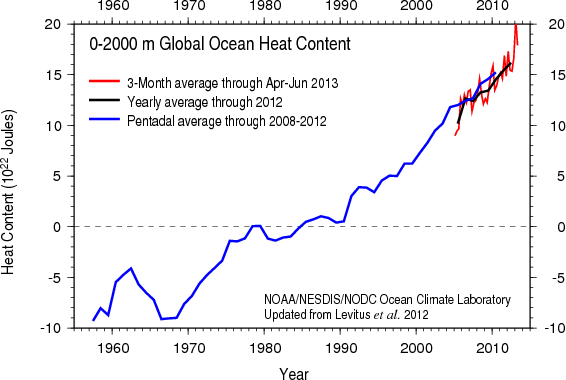
- major media outlets and average citizen observations now agree that the temperature rise "paused" 10 or 15 years ago. True believers are now deviously attempting to switch the evidence from thermometers to glacial footprint and deep ocean temperature oscillations. Next year will a random huricane be used to bamboozle the public again?

Release Hanson's (taxpayer funded) raw data and let everyone take a look. Unless there's something to hide.

good dog, what an obscenely stupid post, starting with the claim that they're switching from using thermometers to using them in the oceans. And since when are steadily increasing ocean temps "oscillations". Do you even know what the word means birdbrain? http://en.wikipedia.org/wiki/Oscillation

Perhaps you can point them out for me on this graph?


show us the point of equilibrium around which the temps are oscillating, eh birdbrain?

Oh that's right, there isn't one.

and I'm sure Hansen will be coming outta retirement soon to relaease the raw data he's been hiding all this time, even from the Koch Brothers. http://www.google.com/url?sa=t&rct=...MuGuTzsln1vgEzmZniz-95g&bvm=bv.60444564,d.aWc
 
Pres Obama's SOTU comments on climate change:

"It’s not just oil and natural gas production that’s booming; we’re becoming a global leader in solar, too. Every four minutes, another American home or business goes solar; every panel pounded into place by a worker whose job can’t be outsourced. Let’s continue that progress with a smarter tax policy that stops giving $4 billion a year to fossil fuel industries that don’t need it, so that we can invest more in fuels of the future that do. And even as we’ve increased energy production, we’ve partnered with businesses, builders, and local communities to reduce the energy we consume. When we rescued our automakers, for example, we worked with them to set higher fuel efficiency standards for our cars. In the coming months, I’ll build on that success by setting new standards for our trucks, so we can keep driving down oil imports and what we pay at the pump. Taken together, our energy policy is creating jobs and leading to a cleaner, safer planet. Over the past eight years, the United States has reduced our total carbon pollution more than any other nation on Earth. But we have to act with more urgency – because a changing climate is already harming western communities struggling with drought, and coastal cities dealing with floods. That’s why I directed my administration to work with states, utilities, and others to set new standards on the amount of carbon pollution our power plants are allowed to dump into the air. The shift to a cleaner energy economy won’t happen overnight, and it will require tough choices along the way. But the debate is settled. Climate change is a fact. And when our children’s children look us in the eye and ask if we did all we could to leave them a safer, more stable world, with new sources of energy, I want us to be able to say yes, we did.
How many times during the speech did you have to change your panties?
 
for those who believe in science, climate change is settled. it's fact.
for primitives who believe the Bible trumps science, it isn't.
Bible has nothing to do with it. When your "Scientists" tell us why the earth hasn't warmed in over 16 years, then we'll talk.
 
I'll take a couple of accurate predictions, an explanation as to why the rest of the planets are warming as well at the same rate, and proof that the IPCC hasn't colluded with the academic community to manipulate the data. Then I'll consider it. In the meantime, I will believe my own eyes over that of the "majority of experts".
The predictions have been accurate, just not precise.

If I can point you to data showing the other planets haven't had the same trend, in terms of duration and magnitude, will that end your objections?

How does one prove a lack of collusion?
 
Back
Top