New Posts
  • Hi there guest! Welcome to PoliticalJack.com. Register for free to join our community?

SNOPES

The link showed that the economy was growing again in 1933. The symptoms of the depression, the number of failing banks, the unemployment numbers and business failures were all getting worse up until 1933 when FDR took over. The decline in GDP had been more than 30%...and was not showing any sign of improving on it's own.

The depression of 1920 was entirely related to factory shutdowns that were voluntary as they shifted back to non-military production. As soon as they were done with that the workers would all come back to work and the production would go back to normal or even better, since demand would have been there the entire time. No "market clearing" was needed.

The depression of 1929 was world wide...the depression of 1920 was not.

What, exactly, do you think "market clearing" is? That was precisely what it was (in 1921). What caused the deflation (if it was just "voluntary" factory retooling)? Your characterization of all these economic episodes is, well, convenient. If it was really the result of war production ending, why wasn't there a (deflationary) depression in 1946 as WWII ended? The depression of 1920 didn't spread world wide because it was over so fast. The one in 1929 went global because Herbert Hoover tried to use government intervention (as he had recommended in 1920 as Harding's Commerce Secretary but was rejected) to "fix" what was wrong with the economy. A policy set FDR embraced, and expanded, as the depression dragged on. That's not a coincidence.
 
What, exactly, do you think "market clearing" is? That was precisely what it was (in 1921). What caused the deflation (if it was just "voluntary" factory retooling)? Your characterization of all these economic episodes is, well, convenient. If it was really the result of war production ending, why wasn't there a (deflationary) depression in 1946 as WWII ended? The depression of 1920 didn't spread world wide because it was over so fast. The one in 1929 went global because Herbert Hoover tried to use government intervention (as he had recommended in 1920 as Harding's Commerce Secretary but was rejected) to "fix" what was wrong with the economy. A policy set FDR embraced, and expanded, as the depression dragged on. That's not a coincidence.

When did Hoover become Treasury Secretary?
 
What, exactly, do you think "market clearing" is? That was precisely what it was (in 1921). What caused the deflation (if it was just "voluntary" factory retooling)? Your characterization of all these economic episodes is, well, convenient. If it was really the result of war production ending, why wasn't there a (deflationary) depression in 1946 as WWII ended? The depression of 1920 didn't spread world wide because it was over so fast. The one in 1929 went global because Herbert Hoover tried to use government intervention (as he had recommended in 1920 as Harding's Commerce Secretary but was rejected) to "fix" what was wrong with the economy. A policy set FDR embraced, and expanded, as the depression dragged on. That's not a coincidence.

You are getting pretty desperate here to claim the world wide economy of 1919 was the same as in 1945.....
 
The idea that the moon is "made of green cheese" isn't supported by logic, the way my argument here is. So that is what we refer to as a "straw man." I have linked repeatedly to historical accounts that recount how the depression contributed to the tensions that boiled over into war in the 1930s. And I also linked the study that illustrates how Roosevelt was responsible for extending the length of the Great Depression (an argument that is abundantly supported by the fact that the economy, which always recovers fully and quickly after downturns, failed to do so during the decade after he first won election). And then, the coup de grace is the credible accounts that FDR, at the end of the decade, as the reality that his economic policies were not ever going to engender an economic recovery sunk in :

http://dailysignal.com/2009/01/14/were-spending-more-than-ever-and-it-doesnt-work/

That he engineered the US entrance into the global contagion that ongoing economic malaise had produced:

http://www.independent.org/issues/article.asp?id=408

Effectively engineering the beginning if WWII.

So I'm in no way making a "moon is green cheese" argument here, but rather merely interpreting the historical facts in a way that is inconvenient for left wing FDR sycophants to digest, in that it indicts their demigod of big government anti-capitalism as a complete failure, albeit in opposition to the conventional narrative that he somehow "fixed" the depression and "saved the world."

FDR was a powerful man, but a complete loser of a President; one whose economic policies failed miserably (as the length of the Great Depression shows) and, rather than "saving" the world, actually played a large role in the events that precipitated WWII. It is simply because of the (misplaced) hero worship of people like you, who let their ideology determine who is worthy of honor, rather than results (see Barack Obama for reference), that our historical narrative paints FDR in such a glowing historical light.

Your entire argument here boils down to "na nanana na na, I can't hear you." Instead of lifting a finger to refute any of the points I have made, you prefer to hide behind this fake argument that my argument has no facts underpinning it so you can simply dismiss it out of hand. As I have repeatedly shown, there are facts that underpin every step of my process that lead to my position. That's called logic, not "green cheese." You should try some.

As for your position on recession/depression, they ARE all the same - dislocation in one or more (sub)markets in an economy, leading to idled productive capacity and workers (unemployment). It is not ever, as the Keynesians would have it, a "lack of demand" (demand is infinite) that causes them, so lets dispense with that up front. Then there is difference in the depth and length of the downturns that result from these (various) market dislocations. To some minor extent, that might have some effect from which of the tens of thousands (if not hundreds of thousands) of (sub)markets that make up an economy, are involved (housing being perhaps more difficult to clear than autos) in the initial downturn. And, of course, how many other markets are brought into dislocation as a result of the initial market(s) that dislocate to cause the initial downturn. But on the margin, the length and depth is a function of the policy response of government officials - put government in the way, the downturn endures; get it out of the way, and the economy begins to heal almost immediately:

https://mises.org/library/forgotten-depression-1920

The sooner you let the markets clear, the fewer other (sub)markets get dragged into the downturn, and the sooner the recovery can begin. Lefties like you seek to perpetuate the narrative that these matters are more complicated than they are for the simple purpose of supporting their big government (anti-market) bias. If all recessions/depressions are "different" well then "we better have a legion of lefty propeller heads in charge to diagnose and implement interventions that will 'fix' these pesky markets that can't figure this stuff out on their own, and allow them to overcome their own innate inability to understand what is in their own best interests." Sound familiar? It should - that's your idiotic Keynesianism in a nutshell. You probably can't even see the inherent anti-capitalism in that viewpoint. "Why I'm an entrepreneur, I own a restaurant, so that makes me automatically a capitalist" you might be thinking. But, unfortunately, you are wrong. It is a belief in markets that makes you a capitalist, not simply a willingness to engage in them while supporting efforts to place government in control of them. But, back to my point, the actual historical records show that the more interventionist the government (think FDR, Barack Obama) the longer the downturn. This isn't the result of these downturns being somehow "different," but rather how different the political response was. The more the government interferes to "fix" the economic problems, the less robust the recovery. You may not like the fact that history proves this correct, but it is in fact, a fact.

You engage in your fantasy version of the economy solely because you hope to gain points for the left wing of the democratic party.

Why wouldn't they have prepared for the attack on Pearl Harbor if they knew it was coming ? It would have still been an act of war anyway, we still would have gone to war over the attack, and surely it would have been better to set up a trap so that you could destroy as much of the enemy forces as possible. Why instead allow them to destroy as much of your own forces as possible ?
 
Then why is it that it was the heart and soul of the USSR's economic "success?"

How so? The USSR achieved its greatest success during peacetime and while maintaining a modest military budget ... it began to collapse as it aped the empire-building capitalists.
 
The idea that the moon is "made of green cheese" isn't supported by logic, the way my argument here is. So that is what we refer to as a "straw man." I have linked repeatedly to historical accounts that recount how the depression contributed to the tensions that boiled over into war in the 1930s. And I also linked the study that illustrates how Roosevelt was responsible for extending the length of the Great Depression (an argument that is abundantly supported by the fact that the economy, which always recovers fully and quickly after downturns, failed to do so during the decade after he first won election). And then, the coup de grace is the credible accounts that FDR, at the end of the decade, as the reality that his economic policies were not ever going to engender an economic recovery sunk in :

http://dailysignal.com/2009/01/14/were-spending-more-than-ever-and-it-doesnt-work/

That he engineered the US entrance into the global contagion that ongoing economic malaise had produced:

http://www.independent.org/issues/article.asp?id=408

Effectively engineering the beginning if WWII.

So I'm in no way making a "moon is green cheese" argument here, but rather merely interpreting the historical facts in a way that is inconvenient for left wing FDR sycophants to digest, in that it indicts their demigod of big government anti-capitalism as a complete failure, albeit in opposition to the conventional narrative that he somehow "fixed" the depression and "saved the world."

FDR was a powerful man, but a complete loser of a President; one whose economic policies failed miserably (as the length of the Great Depression shows) and, rather than "saving" the world, actually played a large role in the events that precipitated WWII. It is simply because of the (misplaced) hero worship of people like you, who let their ideology determine who is worthy of honor, rather than results (see Barack Obama for reference), that our historical narrative paints FDR in such a glowing historical light.

Your entire argument here boils down to "na nanana na na, I can't hear you." Instead of lifting a finger to refute any of the points I have made, you prefer to hide behind this fake argument that my argument has no facts underpinning it so you can simply dismiss it out of hand. As I have repeatedly shown, there are facts that underpin every step of my process that lead to my position. That's called logic, not "green cheese." You should try some.

As for your position on recession/depression, they ARE all the same - dislocation in one or more (sub)markets in an economy, leading to idled productive capacity and workers (unemployment). It is not ever, as the Keynesians would have it, a "lack of demand" (demand is infinite) that causes them, so lets dispense with that up front. Then there is difference in the depth and length of the downturns that result from these (various) market dislocations. To some minor extent, that might have some effect from which of the tens of thousands (if not hundreds of thousands) of (sub)markets that make up an economy, are involved (housing being perhaps more difficult to clear than autos) in the initial downturn. And, of course, how many other markets are brought into dislocation as a result of the initial market(s) that dislocate to cause the initial downturn. But on the margin, the length and depth is a function of the policy response of government officials - put government in the way, the downturn endures; get it out of the way, and the economy begins to heal almost immediately:

https://mises.org/library/forgotten-depression-1920

The sooner you let the markets clear, the fewer other (sub)markets get dragged into the downturn, and the sooner the recovery can begin. Lefties like you seek to perpetuate the narrative that these matters are more complicated than they are for the simple purpose of supporting their big government (anti-market) bias. If all recessions/depressions are "different" well then "we better have a legion of lefty propeller heads in charge to diagnose and implement interventions that will 'fix' these pesky markets that can't figure this stuff out on their own, and allow them to overcome their own innate inability to understand what is in their own best interests." Sound familiar? It should - that's your idiotic Keynesianism in a nutshell. You probably can't even see the inherent anti-capitalism in that viewpoint. "Why I'm an entrepreneur, I own a restaurant, so that makes me automatically a capitalist" you might be thinking. But, unfortunately, you are wrong. It is a belief in markets that makes you a capitalist, not simply a willingness to engage in them while supporting efforts to place government in control of them. But, back to my point, the actual historical records show that the more interventionist the government (think FDR, Barack Obama) the longer the downturn. This isn't the result of these downturns being somehow "different," but rather how different the political response was. The more the government interferes to "fix" the economic problems, the less robust the recovery. You may not like the fact that history proves this correct, but it is in fact, a fact.

You engage in your fantasy version of the economy solely because you hope to gain points for the left wing of the democratic party.

"Demand is infinite" only under conditions of production for need. Under conditions of production for profit, it is limited by consumer purchasing power.
 
why lie...no post of mine claims the economy was great in the 30's.

I posted facts...which you have failed to refute. you continue to post opinions that you pretend prove FDR started ww2 to bail out his economy...forgetting that war in europe started in 1939 and the US stayed out until Hitler declared war on us. War in Asia started in 1931 and we stayed out until attacked...

Why did Germany declare war on the U.S.? Because the U.S. declared war on Japan. Why did the U.S. do that? Because Japan attacked Pearl Harbor. Why? Because the U.S. embargoed steel, oil, and other things Japan needed to feed its people. Why's they do that? Because Japan was building a colonial empire that interfered with the U.S.'s ability to find overseas markets for its products. In short: economics.
 
What, exactly, do you think "market clearing" is? That was precisely what it was (in 1921). What caused the deflation (if it was just "voluntary" factory retooling)? Your characterization of all these economic episodes is, well, convenient. If it was really the result of war production ending, why wasn't there a (deflationary) depression in 1946 as WWII ended? The depression of 1920 didn't spread world wide because it was over so fast. The one in 1929 went global because Herbert Hoover tried to use government intervention (as he had recommended in 1920 as Harding's Commerce Secretary but was rejected) to "fix" what was wrong with the economy. A policy set FDR embraced, and expanded, as the depression dragged on. That's not a coincidence.

There was a recession in 1946. The U.S. largely escaped it by setting up a permanent war economy much like the one Germany had set up the previous decade.
 
What, exactly, do you think "market clearing" is? That was precisely what it was (in 1921). What caused the deflation (if it was just "voluntary" factory retooling)? Your characterization of all these economic episodes is, well, convenient. If it was really the result of war production ending, why wasn't there a (deflationary) depression in 1946 as WWII ended? The depression of 1920 didn't spread world wide because it was over so fast. The one in 1929 went global because Herbert Hoover tried to use government intervention (as he had recommended in 1920 as Harding's Commerce Secretary but was rejected) to "fix" what was wrong with the economy. A policy set FDR embraced, and expanded, as the depression dragged on. That's not a coincidence.

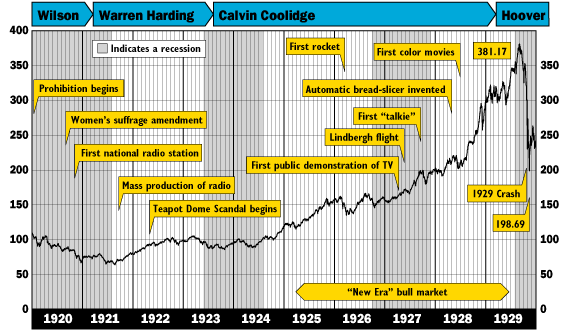
In 1929 the situation was dramatically different than 1920. There was no Wall Street crash in 1920. Notice the timing of the recession...it was over almost as soon as Harding became president.

graph1920-1929.gif


You made a big deal out of a cut in government spending under Harding...In fact he wasn't president when that huge cut in spending happened.

Federal-Outlays-FY-1919-1924.png

Why did Germany declare war on the U.S.? Because the U.S. declared war on Japan. Why did the U.S. do that? Because Japan attacked Pearl Harbor. Why? Because the U.S. embargoed steel, oil, and other things Japan needed to feed its people. Why's they do that? Because Japan was building a colonial empire that interfered with the U.S.'s ability to find overseas markets for its products. In short: economics.
we embargoed products to force them to stop their occupation and war in asia. they didn't need US oil or steel to feed their people. they needed those things to make war.
 
Why wouldn't they have prepared for the attack on Pearl Harbor if they knew it was coming ? It would have still been an act of war anyway, we still would have gone to war over the attack, and surely it would have been better to set up a trap so that you could destroy as much of the enemy forces as possible. Why instead allow them to destroy as much of your own forces as possible ?

Why ignore the President's Daily Brief that says bin Laden is "determined to strike within the USA?"
 
How so? The USSR achieved its greatest success during peacetime and while maintaining a modest military budget ... it began to collapse as it aped the empire-building capitalists.

I'm not sure any of its history was "a success." It was the "guns and butter" strategy that destroyed its economy, just like it has with ours...
 
In 1929 the situation was dramatically different than 1920. There was no Wall Street crash in 1920. Notice the timing of the recession...it was over almost as soon as Harding became president.

graph1920-1929.gif


You made a big deal out of a cut in government spending under Harding...In fact he wasn't president when that huge cut in spending happened.

Federal-Outlays-FY-1919-1924.png


we embargoed products to force them to stop their occupation and war in asia. they didn't need US oil or steel to feed their people. they needed those things to make war.

The stock market is not the economy. Isn't now and wasn't then. The stock market is still making record all time highs, and yet the economy struggles along at 1.5 - 2% growth. The stock market has zero effect on GDP growth. All a stock market crash does, when it precipitates a recession (and occurs during an incompetent big government Republican administration), is to give anti-capitalist demagogues like FDR and Barack Obama a platform upon which to run against "the failure of capitalism."

How come we didn't have a decade of depression after 1987?

Why do you think the stock market crashed in October 1987? Many people point at events that had little to do with the economy. That is why the economy was unaffected.

The recession of 1927 was caused by Henry Ford shutting down factories to retool for a new model.

The recession of 1973 was caused by oil price shocks, federal wage and price controls and taking the country off of the gold standard.

In 1980 we had a recession caused by the Fed raising interest rates as well as the oil embargo from Opec.

In 1990 we had another recession caused by the S&L crash.

How you can claim all recessions are the same and therefore all are solved by doing nothing puzzles me.

Q4 2008 the GDP dropped by 8%. In that case the Stock Market crashed because of the economic conditions.

You are the one who tried to make the argument that a lack of stock market crash in 1920 somehow made that downturn "less significant" than the Great Depression. You keep moving the goalposts and I'll keep posting facts, and we'll just let the chips fall where they may:

Screen Shot 2017-10-21 at 11.52.43 AM.png

Screen Shot 2017-10-21 at 11.55.31 AM.png

By all indications the 1920/21 downturn was worse than the initial 1929/30 downturn, at least in the REAL economy. The fact that the one in 1929/30 was followed by two more years of decline says more about what was done in 1929-33, not what wasn't done. This is just simple logic. The fact that you keep denying it says more about your argument here than it does about mine.
 
You are the one who tried to make the argument that a lack of stock market crash in 1920 somehow made that downturn "less significant" than the Great Depression. You keep moving the goalposts and I'll keep posting facts, and we'll just let the chips fall where they may:

View attachment 37591

View attachment 37592

By all indications the 1920/21 downturn was worse than the initial 1929/30 downturn, at least in the REAL economy. The fact that the one in 1929/30 was followed by two more years of decline says more about what was done in 1929-33, not what wasn't done. This is just simple logic. The fact that you keep denying it says more about your argument here than it does about mine.

I did not argue significance....I was saying the lack of a wall street crash indicates just how localized the 1920 economic event was. 1929 was world wide, 1920 was not. Production dropped 7% in 1920...nearly 9% in 1929 alone and another 6.5% in 1930. The stock market
was hardly affected in 1920...it dropped 90% after the 1929 crash.

By the way, when did buying stock on margin become an issue? How about consumer credit? Those were both factors in 1929 that were not an issue in 1920.

https://www.dailykos.com/stories/2008/01/14/436037/-The-1920s-Credit-Bubble

It was 7% vs. 8.5%, not that much different. And deflation was out of control (way worse than in 1929). What do you think is worse for the real economy - stock prices declining more than goods prices, or vice versa? And the (initial) unemployment drop was worse in 1920 than 1929 also. It was clearly a more serious downturn. The fact that it didn't endure (like during the FDR and Obama depressions) is due to the lack of economic interventions in the markets. This isn't rocket science - on what planet is it "conventional wisdom" that interfering in the markets is "good" for the economy? Oh right, only on the planet "Karl" (as in Marx).

The reason production (and employment) continued to drop after the initial downturn in 1929 is because Hoover implemented economic interventions that prevented the markets from clearing (unlike 1921). And FDR followed suit (just like Bushbama). And again, if stock market crashes cause depressions, why wash't there one after the 1987 crash?

Why is it that you find it so difficult to accurately quote any post you read? Where did I say that stock market crashes cause depressions?
 
Back
Top