New Posts
  • Hi there guest! Welcome to PoliticalJack.com. Register for free to join our community?

Settled Science Update

holy sh*t, you are seriously deluded. Didn't you perceive that it was a Google search?

EVERYONE reports geothermal (volcanic) activity along that 1100 mile long ridge; do a little study and you will discover that the entire mountain range rose up in the same half century the Arctic ice was melting. Did you read the article I painstakingly copied pasted for you into 3 posts?

Let's compare the temperature (in Fahrenheit) of geothermal gas versus the average air temps in the Arctic circle. Which one do you think was melting the ice cap? (hint: the one that was hotter)

avg air temps at North pole: .................. -10 degrees
geothermal gas from ocean floor: .......... 3000 degrees

Here's a little dilemma that I pointed out years ago to you. Air temps below freezing (32 degrees) don't actually melt ice. In fact, they freeze water into more ice. You never managed to wrap your head around that either.

I don't mean to insult you, but how else can I characterize this "science" than utter nonsense? You refuse to acknowledge the geothermal activity associated with an entire mountain range rising on the ocean floor and steadfastly maintain that air temps that averaged 4o degrees below freezing are what melted the ice cap. That's looney tunes.

Average temperature doesn't mean average summer temperature. It melts in the summer as the air rises above water's freezing point.
 
How so? Making a law doesn't change anything. Let's see your proof.

My comment was snark, I didn't really look into your quotations (or misquotations) at all. But, for example, the Endangered Species Act is credited with saving many well-known endangered species including the California condor and the bald eagle.
 
Carbon14_with_activity_labels.svg

What's the source for this reconstruction, and why does it appear to differ so much from the reconstructions by dozens of reputable climate scientists? Is it just because it appears to end in about 1990, right before temperatures took off?
 

Yet climate models that only take into account solar variation, melting ice, volcanoes, etc., can't account for observed trends in temperature.
 
I can see a few options here:

(1) You used to be more sure that AGW isn't real, but the huge amount of new data and analysis has undermined that belief for you, and so now you're neutral on the question.
(2) You used to be more sure AGW is real, but somehow the huge amount of new supporting data actually decreased your confidence, making you neutral on it.
(3) You used to be neutral on the topic, and are neutral on it again, but in between you had a period of being non-neutral on it, with your moves away from and back to neutrality having something to do with new information along the way.

Is it one of those three? If so, which one? Or if it's something else entirely, what is it? Or is the truth that you were neutral all along, with the massive number of new facts and analysis making no impact on your mind, because it was closed to them?

Apparently, you are unable to make peace with your error. You'll have to get past it somehow......I wish you well. You can keep hectoring if you feel you must, but this isn't healthy, so I won't be replying anymore. That leaves you free to say anything you wish unchallenged, you need it far more than I.
 
Average temperature doesn't mean average summer temperature. It melts in the summer as the air rises above water's freezing point.
that is astoundingly stupid.

astoundingly wrong.

You look at the average temp to determine if the air temp is adding ice or depleting ice. In the summer at the North Pole it can get as warm as 40 degrees (F) - so yeah a little ice melts - but in the winter it drops to 50 and 60 below zero (F) - so the air temp is freezing water at a much higher rate than it is melting in the summer - the average temp of 40 degrees below freezing (F) tells you that the air temps are not depleting ice from the Arctic ice cap, they are adding ice to it. So pretending that greenhouse gases are warming the air and that is melting the ice cap is astoundingly stupid.

It was a swing and a miss. The ice cap was depleted by geothermal activity on the ocean floor. duh.
 
EVERYONE reports geothermal (volcanic) activity along that 1100 mile long ridge

I'm not denying there's geothermal activity there. I'm saying that the leading experts who study the issue don't believe it has any significant role in the melting.

Air temps below freezing (32 degrees) don't actually melt ice. In fact, they freeze water into more ice.

What you still haven't wrapped your head around is the fact it's the near-surface water that's been warming up and melting the ice -- water that's flowing in from warmer climes, where it's getting warmer than in the past thanks to the surrounding air being warmer. If the geothermal heating were responsible for much of the ice melting, we'd expect a specific pattern of data (e.g., significantly rising temps much lower in the water column). that's not the pattern we see. We see a pattern consistent with the mainstream scientific consensus.
 
I'm not denying there's geothermal activity there. I'm saying that the leading experts who study the issue don't believe it has any significant role in the melting.


What you still haven't wrapped your head around is the fact it's the near-surface water that's been warming up and melting the ice -- water that's flowing in from warmer climes, where it's getting warmer than in the past thanks to the surrounding air being warmer. If the geothermal heating were responsible for much of the ice melting, we'd expect a specific pattern of data (e.g., significantly rising temps much lower in the water column). that's not the pattern we see. We see a pattern consistent with the mainstream scientific consensus.
first of all, yes you did deny it existed, that was why I did the search; which was kind of nice because I noticed they now have a name for the mountain ridge. 2nd of all, most scientists still believe heat rises, if you doubt this law of physics, just search for YouTube videos of geothermal vents on the ocean floor, which direction do the bubbles travel? Do you think the heat stops rising or do you think it continues to rise to the surface, melts a bunch of ice, travels out to the edge of the ice cap where it can escape into the atmosphere, seriously melting the edge of the ice cap, then rises in the atmosphere, warming air temps as well?

Why don't you tell me what happens to the heat from the volcanic activity on the ocean floor... I just love hearing you break all the laws of physics so you can have your looney tunes religion.
 
first of all, yes you did deny it existed

If I worded it badly, my apologies, but it was certainly not my intent to deny there's volcanic activity there. I'm well aware that there's volcanic activity all along the various tectonic plates, and that would include in places in the Arctic sea floor. I'm just not aware of anything showing that the overall volcanic activity has increased in a way that would explain the huge increase in the temperatures. There was volcanic activity in the Arctic in the past, and still is. Is there any evidence there's more now than before? If so, is the extra enough to explain any more than a tiny fraction of the heat required to melt that much ice?

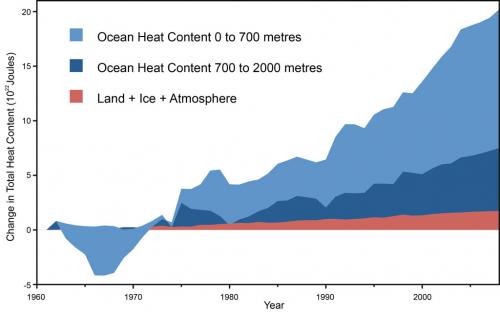
Keep in mind the mind-blowing energy required to produce the kinds of temperature increases we've seen. See here, for example:

Nuccitelli_OHC_Data_med.jpg


We're talking something on an order of magnitude of 2.0*10^23 Joules over the course of four decades. Mount St. Helens, by comparison, put out about 1.7*10^17 joules of energy. So, you'd need about 1.18*10^6 Mt. St. Helens eruptions to account for that heat gain. That would be about 81 Mt. Saint Helens-magnitude eruptions happening EVERY DAY for the last forty years. And, again, that's not the TOTAL geothermal output that would be needed. It's just the INCREASE in the geothermal output, relative to the prior level, to account for the increase in the heat. So if suddenly the ocean were experiencing 81 more monster volcanic explosions per day than in previous eras, wouldn't we expect to notice?

Do you think the heat stops rising or do you think it continues to rise to the surface, melts a bunch of ice, travels out to the edge of the ice cap where it can escape into the atmosphere, seriously melting the edge of the ice cap, then rises in the atmosphere, warming air temps as well?

Over the long term, it rises to the surface. However, what the experts were saying, in the links I provided, is that not much of it rises to the surface in that area, where it would heat the caps. It's carried away by deep ocean currents and ultimately most of it rises elsewhere, which further complicates any attempt to attribute any great portion of the melting to that activity. It was already a multiple-order-of-magnitude mismatch between the heat source and the phenomenon you're trying to explain, and the less focused the heat is on that area, the harder it gets to make the two match up.
 
Sure it has. Pull up any historical record of global temperatures and take a look. For example, NASA and NOAA publish an instrument record going back to 1880, showing average global temperatures. The Japan Meteorological agency and the UK's Met office have similar records going back to the late 1800s, with slightly different methods. Take whichever you want, and do some simple math. What was the average rise in temperature in the first fifth, second fifth, etc., of the record? You'll see a clear trend of acceleration.

Or, if you want to go back further, take one of the paleoclimate reconstructions, going back thousands of years. What was the pace of warming (or cooling) in various periods. How does that compare to the pace of warming in, say, the last half century?

Make an honest effort to answer those questions for yourself and you'll see what I mean.
False models, created on computers, by individuals with a nefarious agenda. The average temperature hasn't risen substantially for 20 years or so now. The Arctic ice packs are not decreasing, the polar bear population is not dying out, and the West Side Freeway, in new York, is not underwater.
 
What's the source for this reconstruction, and why does it appear to differ so much from the reconstructions by dozens of reputable climate scientists? Is it just because it appears to end in about 1990, right before temperatures took off?

it's a Wikipedia article.

https://en.wikipedia.org/wiki/Solar_cycle

the analysis was done by radiocarbon dating, because there aren't reliable sunspot observations going back any length of time.

additionally, when you use radiocarbon dating, you can't use organic material which was just recently deposited. link to Wikipedia article above.
 
False models, created on computers, by individuals with a nefarious agenda. The average temperature hasn't risen substantially for 20 years or so now. The Arctic ice packs are not decreasing, the polar bear population is not dying out, and the West Side Freeway, in new York, is not underwater.
What makes you think the average temperature hasn't risen substantially for 20 years or so? Here's what it looks like graphed:

graph.png


If you prefer NOAA to NASA, here's their dataset for download:

https://www.ncdc.noaa.gov/cag/time-series/global/globe/land_ocean/ytd/12/1880-2017.csv

In the most recent year, the global temperature anomaly was 0.93. 20 years earlier, in 1996, it was 0.32. That's a rise of 0.61 degrees in just 20 years. To put how significant that is in context, it's almost 50% more warming that you'll see in the previous 126 years combined.

Presumably the argument you're trying to make is the one the denialists used to attempt a few years back. Thanks to an extremely intense El Nino in 1998, we didn't break above the 1998 temperature anomaly until 2010, and we didn't break above it by a significant margin until 2014. Thus, there was a sixteen year run that a dishonest person could point to and claim global warming had stopped for that time. But, of course, the obvious fault with that was that you were measuring from a known peak in a cycle to a later trough. With non-El Nino years already starting to move past 1998 by small margins, it was obvious that the next El Nino year would surge past it by a big margin. And that's just what happened, with 2016 having a temperature anomaly almost 50% larger than 1998. That came as no surprise at all to those of us who were listening to the experts. We knew perfectly well the next El Nino would blow away the last one. But it's not at all the kind of thing you'd have expected if you were one of those imbeciles who'd bought the right-wing talking point about global warming having stopped.
 
I can drop this 50 pound dumbbell and not worry about it slamming into my foot that's directly below it. Gravity is a liberal conspiracy. The actual cause of things appearing to fall to Earth are undersea volcanoes, and since there are none of them around me, I'm good.

Well, that's ridiculous.


You could never lift a 50 pound dumbbell...
 
that is astoundingly stupid.

astoundingly wrong.

You look at the average temp to determine if the air temp is adding ice or depleting ice. In the summer at the North Pole it can get as warm as 40 degrees (F) - so yeah a little ice melts - but in the winter it drops to 50 and 60 below zero (F) - so the air temp is freezing water at a much higher rate than it is melting in the summer - the average temp of 40 degrees below freezing (F) tells you that the air temps are not depleting ice from the Arctic ice cap, they are adding ice to it. So pretending that greenhouse gases are warming the air and that is melting the ice cap is astoundingly stupid.

It was a swing and a miss. The ice cap was depleted by geothermal activity on the ocean floor. duh.

Higher summer temperatures and much higher (even if below freezing) winter temperatures means less ice forming every winter and more melting every summer.
 
Well, that's ridiculous.


You could never lift a 50 pound dumbbell...
I do three sets of eight with 50 pound dumbbells as a regular part of my workout. When I was younger, I was way into arm wrestling and used to do it with 75-pounders. I'd be lucky to curl 75 once, at this point. I also used to do a bunch of pull-ups, and to work with "Titans of Crush" grippers. It was my thing.
 
Higher summer temperatures and much higher (even if below freezing) winter temperatures means less ice forming every winter and more melting every summer.
It does? What is that? A slogan? I guess when you can't stand up to simple science, use a slogan, eh?

I can not believe how dense you two are behaving, it is as if, 5th grade science escapes you.

Let's try this again. If the average air temp for the year is below freezing, then air temps are adding to the ice cap... more water is freezing than ice is melting.

sigh.

You do get that, don't you?

If the average air temp for the year is 40 degrees below freezing; then air temps are way and far gone adding more ice to the ice cap... it isn't even close to depleting the ice cap.

If geothermal activity is kicking the average air temp up to 35 or even 30 degrees below freezing, air temps are still freezing way more water than they are melting ice.

Sooooooooooo, the water is warming the air, not greenhouse gases. Why do we know that? Because we know geothermal activity is warming the water and that heat keeps rising into the air, so it has to heat the air.

At any rate, you two are the last "scientists" still wacky enough to think that greenhouse gases melted the Arctic ice cap.
 
I do three sets of eight with 50 pound dumbbells as a regular part of my workout. When I was younger, I was way into arm wrestling and used to do it with 75-pounders. I'd be lucky to curl 75 once, at this point. I also used to do a bunch of pull-ups, and to work with "Titans of Crush" grippers. It was my thing.

With those little, tiny hands? Not a chance...
 
If I worded it badly, my apologies, but it was certainly not my intent to deny there's volcanic activity there. I'm well aware that there's volcanic activity all along the various tectonic plates, and that would include in places in the Arctic sea floor. I'm just not aware of anything showing that the overall volcanic activity has increased in a way that would explain the huge increase in the temperatures. There was volcanic activity in the Arctic in the past, and still is. Is there any evidence there's more now than before? If so, is the extra enough to explain any more than a tiny fraction of the heat required to melt that much ice?

Keep in mind the mind-blowing energy required to produce the kinds of temperature increases we've seen. See here, for example:

Nuccitelli_OHC_Data_med.jpg


We're talking something on an order of magnitude of 2.0*10^23 Joules over the course of four decades. Mount St. Helens, by comparison, put out about 1.7*10^17 joules of energy. So, you'd need about 1.18*10^6 Mt. St. Helens eruptions to account for that heat gain. That would be about 81 Mt. Saint Helens-magnitude eruptions happening EVERY DAY for the last forty years. And, again, that's not the TOTAL geothermal output that would be needed. It's just the INCREASE in the geothermal output, relative to the prior level, to account for the increase in the heat. So if suddenly the ocean were experiencing 81 more monster volcanic explosions per day than in previous eras, wouldn't we expect to notice?


Over the long term, it rises to the surface. However, what the experts were saying, in the links I provided, is that not much of it rises to the surface in that area, where it would heat the caps. It's carried away by deep ocean currents and ultimately most of it rises elsewhere, which further complicates any attempt to attribute any great portion of the melting to that activity. It was already a multiple-order-of-magnitude mismatch between the heat source and the phenomenon you're trying to explain, and the less focused the heat is on that area, the harder it gets to make the two match up.
sit down, let me explain to you just how much heat came up from the Arctic Ocean floor.

way more than 81 Mt St Helens explosions every day for 40 years.

A frickin' mountain range 1100 miles long pushed up on the ocean floor. And yes, that's geo thermal activity every day for 40 years, it is still kicking out a massive amount of heat. Did you read anything I linked?

how many Mt St Helens mountains can we fit into a mountain range 1100 miles long?

how about 1100 miles divide by 5 miles = 220 Mt St Helens.

Meanwhile, air temps were averaging at least 30 degrees (F) below freezing, so air temps were adding to the ice cap, even with the heat from the volcanic activity warming the air.

If the geo-thermal heat didn't have to melt so much ice before it escaped into the atmosphere, north pole temps would have become tropical over the past 40 years.

carbon dioxide is not going to produce heat in the air at the North pole anyway; the angle of the sun's rays are so extreme, there's nothing there for the carbon dioxide to work with.

Does carbon dioxide increase air temps? sure. Did carbon dioxide melt any ice in the Arctic Circle? Hell no.
 
What makes you think the average temperature hasn't risen substantially for 20 years or so? Here's what it looks like graphed:

graph.png


If you prefer NOAA to NASA, here's their dataset for download:

https://www.ncdc.noaa.gov/cag/time-series/global/globe/land_ocean/ytd/12/1880-2017.csv

In the most recent year, the global temperature anomaly was 0.93. 20 years earlier, in 1996, it was 0.32. That's a rise of 0.61 degrees in just 20 years. To put how significant that is in context, it's almost 50% more warming that you'll see in the previous 126 years combined.

Presumably the argument you're trying to make is the one the denialists used to attempt a few years back. Thanks to an extremely intense El Nino in 1998, we didn't break above the 1998 temperature anomaly until 2010, and we didn't break above it by a significant margin until 2014. Thus, there was a sixteen year run that a dishonest person could point to and claim global warming had stopped for that time. But, of course, the obvious fault with that was that you were measuring from a known peak in a cycle to a later trough. With non-El Nino years already starting to move past 1998 by small margins, it was obvious that the next El Nino year would surge past it by a big margin. And that's just what happened, with 2016 having a temperature anomaly almost 50% larger than 1998. That came as no surprise at all to those of us who were listening to the experts. We knew perfectly well the next El Nino would blow away the last one. But it's not at all the kind of thing you'd have expected if you were one of those imbeciles who'd bought the right-wing talking point about global warming having stopped.
Well, the phony chart did it for me, I'm convinced now that I need to buy me a cabin, in Colorado on Pikes Peak, up above the Timberline, so when the water rises up to my front porch, I can fish from my rocking chair.
Maybe I need to buy a tree from Al Gore so I can do my part to stave off this man-made disaster. I really feel sorry for all those poor dumb shits who still think that God is in charge of this world, and refuse to bow to the throne of Bill Nye, THE science guy and Al Gore the presidential wannabe.
 
It does? What is that? A slogan? I guess when you can't stand up to simple science, use a slogan, eh?

I can not believe how dense you two are behaving, it is as if, 5th grade science escapes you.

Let's try this again. If the average air temp for the year is below freezing, then air temps are adding to the ice cap... more water is freezing than ice is melting.

sigh.

You do get that, don't you?

If the average air temp for the year is 40 degrees below freezing; then air temps are way and far gone adding more ice to the ice cap... it isn't even close to depleting the ice cap.

If geothermal activity is kicking the average air temp up to 35 or even 30 degrees below freezing, air temps are still freezing way more water than they are melting ice.

Sooooooooooo, the water is warming the air, not greenhouse gases. Why do we know that? Because we know geothermal activity is warming the water and that heat keeps rising into the air, so it has to heat the air.

At any rate, you two are the last "scientists" still wacky enough to think that greenhouse gases melted the Arctic ice cap.

Actually, a firm consensus of qualified scientists (you and I are not) think the same. The air heats the water and the water melts the ice.
 
Back
Top